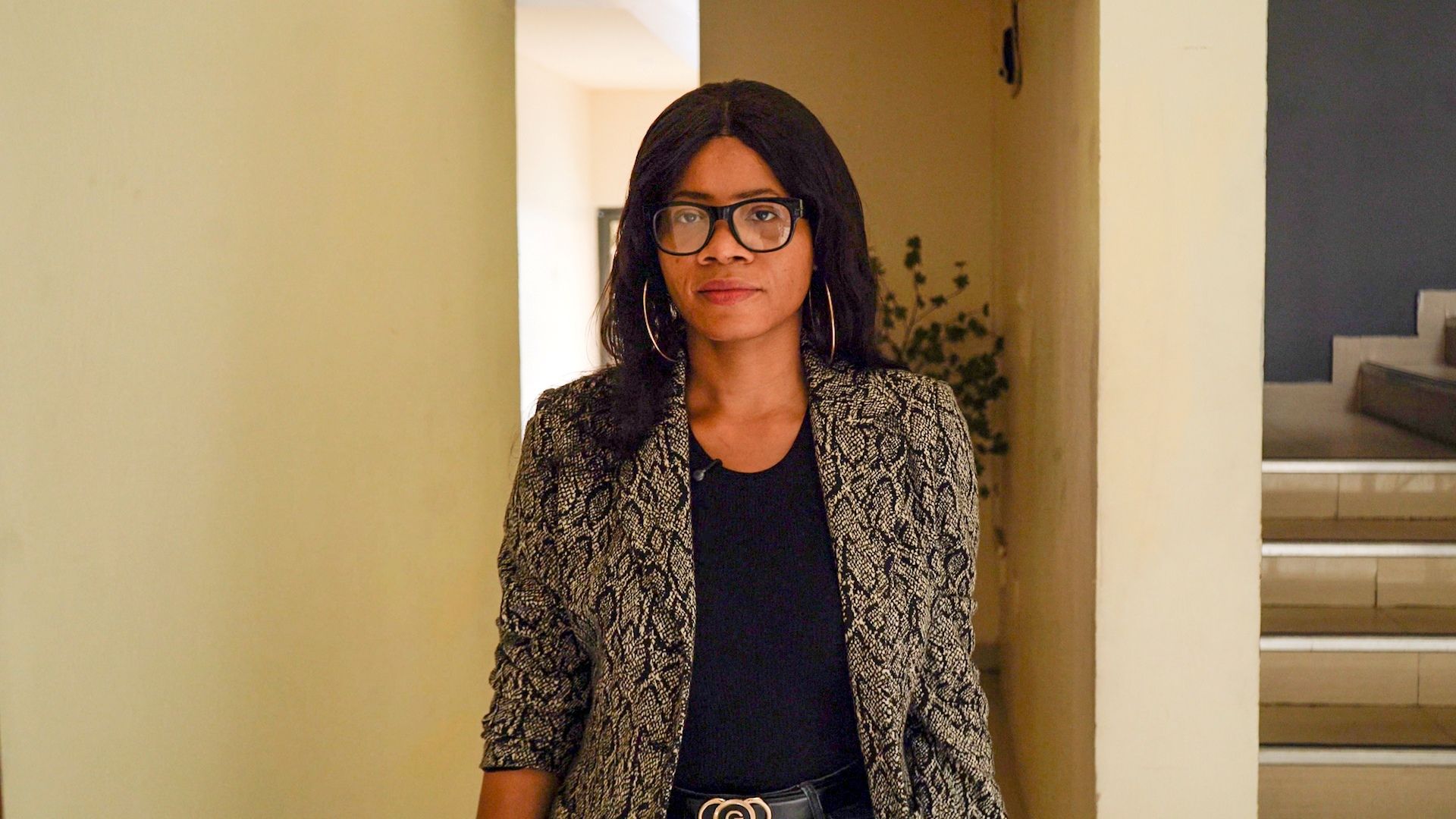


“Look at your face,” one girl told Precious.
Precious knew what was coming. It wasn’t the first time she’d gone through this. She steeled herself for what she knew would be scathing remarks.
“Your face is disgusting!” smirked the girl.
Steeling herself never helped. The words of the little girl pierced deep into Precious Zvimba’s heart, just like the many times when other students were mean to her.
They were in secondary school. At only twelve years old, a skin condition had ravaged Precious’ face, discolouring it. She hadn’t asked for it, and neither had she asked for the epithets her schoolmates threw at her for having the skin condition.
Your face is disgusting…
These words bounced back and forth in her mind, like the sound of a drum beaten hard inside an echoic chamber. More than once, little Precious had nothing precious to see when she looked into a mirror. She gazed, catatonic, at her discoloured face and asked herself in her heart, When will I ever be okay?

A tear broke the bank of her eyes and flowed. And when she recalled her heydays in primary school, when such a facial skin condition was unimaginable and she would participate in public speaking contests, then she thought of how now, in secondary school, she couldn’t participate in such activities because her self-esteem had gone to the dogs, she cried some more.
“If I stand to give a speech,” she thought, gasping with pain at the thought, “students will focus on my discoloured skin. They won’t pay attention to what I am saying.”
However, what little Precious couldn’t see when she looked into the mirror was what her future held. Beyond the discoloured face, she was pre-ordained for greatness, leadership and impact.
But like impure gold that goes through intense heat to be purified, she, too, had her refining fire to go through before her defining.
Little rebels on guava trees
Precious Zvimba was born in 1989 in Bulawayo, Zimbabwe’s second-largest city.
Her dad was a policeman, and as Precious narrated to me over a Google Meet call we had towards the end of 2025, “Dad was a strict disciplinarian.”
She appreciates the by-the-book upbringing under the roof of a strict police officer, conceding, “He shaped me into the disciplined woman I am today.”
Serving your country as a high-ranking police officer (Senior Assistant Commissioner) is a noble career, but like the sun, it has its shadow. For Precious’ dad, the shadow was different assignments across Zimbabwe that forced him to move homes regularly with his family.
Precious recalled, “Growing up, I don’t remember keeping friends for long. We kept moving from one area to another. I attended three primary schools!”
Having a strict father, an African strict father, comes with memories. I wanted to push Precious into opening up about a time she faced her dad’s wrath, a time that can paint a picture of his strictness. Precious broke into laughter, a hearty one that segued her childhood memory.
“One time, we’d moved to Harare,” I listened. “There was this banana plantation in our compound, and guava trees that hung over dad’s garage. My siblings and I loved fruits. But dad had warned us against climbing the guava trees.”
However, Precious and her 3 siblings let the rebels in them take the helm. They decided they wanted the guavas, and nothing would stop them. If it meant disregarding their dad’s warning, then so be it. After all, dad wasn’t home.
“My youngest sister couldn’t climb a tree, so we assured her we’d do the climbing and get her fruits; she needn’t worry.”
But the youngest sister had other thoughts. She, too, wanted to enjoy the rebellion of climbing the forbidden tree. Forbidden fruits do taste the sweetest.
Their youngest sister fell from the tree, crashing to the ground with a thud.
“Imagine, when dad got back, she told him that she fell while climbing with us to get guavas! Dad, instead of punishing her, turned his anger on us and whipped us. To date, we sometimes remind my youngest sister, ‘You got us beaten, yet we’d told you not to climb the guava tree!’”
The dream to be a dermatologist
When Precious was in her first year of high school, her dad passed away. It was a dark moment in their family, but they knew that after the mourning, life had to move on.
Precious continued her studies at Fletcher High School in Gweru, eager to excel and make her dad, whose spirit lived on, proud.
But something crawled up to her and, like a snake, wrapped around her self-esteem, choking it out. A skin condition, cystic acne, ravaged her face when she was about twelve years old. It discoloured her face.
The mockery from her schoolmates worsened the situation.
“The fire I had in me to shine in various areas and co-curricular activities died. I was afraid that people would focus on my skin instead of my abilities. The condition messed up with my mental health, and I remember trying every home remedy in vain. Kids were mean to me. It was such a rough time for me.”
Desperate to fix her skin, Precious soon found purpose in pain. She decided that she’d study hard and grow up to become a dermatologist, so that she would “solve the problem of skin issues for others, and create my brand, a line of skin care products.”
“I took a special interest in Biology, determined to understand and pass the subject,” Precious told me about a subject she’d recognised as her path to a career as a dermatologist.
Despite passing Biology in her final high school examination, she failed in other sciences.
“I was therefore generally unqualified to study sciences in my next level of education. That’s how my dermatology dreams died. Commercials presented an available focus area for my A-Levels, but I didn’t like that path. Humanities stood as my last option, and this path rocked my boat.”
The romance thriller writer
Precious chose the humanities, pursuing Literature in English. But how come Literature and English found a soft spot in her heart?
“I’d been in love with stories and storytelling. Since my Form One, I’d been writing fictional stories, though I’d never really thought much about becoming a novelist. I had also turned to writing as my therapy, an expressive activity to combat the mean words of kids who despised my facial skin. I’d write my feelings.”
In her A-Levels, Precious penned a manuscript, a love story she hand-wrote hundreds of pages of, in a well-covered exercise book. She gave it to her teacher, Mrs Mugumbate, for a review and feedback.
“My Literature in English teacher commented that while she enjoyed my story, she wished I could write more local stories. My works had been inspired by the Western novels I read a lot of, in the romance genre.”
Precious graduated as the best student in her A-Levels. She, however, decided she wanted to pursue Psychology at the university level.
Critical Analysis, a subject in her literature course, had inspired her love for psychology. In class, they had taken apart poems and prose excerpts, exerting meaningful criticism. This activity made Precious wonder what it would feel like to take apart people’s thought processes and understand the influences behind their behaviour. She had a keen interest in understanding the psychology of bullies, herself a victim of bullies who despised her facial skin appearance.
From psychology class to baking for survival
“I was accepted for a degree in Psychology at Midlands State University. But unfortunately, due to financial constraints at home, I dropped out after only my first semester of Uni.”
However, she didn’t give up on her dream to become a psychologist. She hoped to return at a later time. In the meantime, she turned to baking and selling cakes. This was in 2009. She’d learnt the art of baking from her mother growing up.
“I started making a small profit from the baking business I did from home and supplied to clients. I used the money to buy my first internet-enabled phone,” Precious told me, and she laughed after adding, “I can’t really call that phone a smartphone, let’s just call it an internet-enabled phone!”
She also used the profit to buy a beauty care cream, which finally resolved her facial skin discolouration issue.

The relief teacher of English
In 2012, Zimbabwe’s Ministry of Labour opened job applications for relief teachers.
“These are temporary teachers,” said Precious, “who are school leavers, brought in to teach secondary schools for a brief period of time while the main teachers are on leave. I applied for a position as a relief teacher for a remote secondary school in Gokwe South. I was invited to interview. I passed and got the job.”
Precious taught English to form ones and form twos at Cheziya Gokwe High School for a term. While she got her salary for that term, it still wasn’t enough to get her back to the university. She went back to baking, while keeping her eyes open and an ear out for opportunities that could fund her education.
When another opportunity to teach as a temporary teacher opened in 2013, she was selected and placed at Nashville High School in Gweru. However, before she started work, a directive came from the Ministry of Labour, blocking school leavers from filling temporary teaching jobs. Going forward, the directive dictated, temporary teachers had to possess teaching qualifications.
“Just like that, this opportunity went down the drain. It broke me, but I remember that while I was home wallowing in self-pity, I received a call from the HR of Zimbabwe Broadcasting Corporation. I had sent an application earlier on for the position of Radio DJ. I wanted to play music between radio sessions and make commentaries on the latest entertainment news.”
A new light, quickly snuffed out
The HR, however, said there was an opening in the Engineering Department as a trainee technical operator. Precious, desperate for a job, was ready to clutch at straws to keep her dreams afloat. She interviewed for the role and got it. It seemed like her career was finally taking off; she even moved to the city of Harare.
“I worked with the crew behind the scenes, helping with live productions such as news and current affairs. The job opened my mind to new thinking and perspectives; it was very exciting!”
But yet again, fate threw Precious into the fire, her refining fire, when she was retrenched in 2015. She now had a seven-month-old son, and the weight of the retrenchment proved too heavy to bear. She took her child and moved back to Gweru.
Just like the little girl she once was, who looked into the mirror and wondered when things would ever get better, Precious, now a mother, wondered when God would reshuffle her stack of cards, which were undoubtedly stacked up against her.
“Job searching was unkind to me. Without an income and with a seven-month-old son to care for, going back home made sense,” she told me.
Her back against the wall once again, Precious was determined to push back. “If I can send out applications frequently,” she thought, “there must be something out there for me. I can beat the odds. My dawn shall break.”
Broken but unbowed
Broken but unbowed, Precious scoured the internet for job opportunities and sent out applications. She was soon invited to interview for a marketing position.
I wanted to know how she managed to do it, given she had zero background in marketing.
“When I set my mind to something,” she said, “I delve deep into research. I had done my homework on marketing and used my findings to tailor my application. The role was at a company owned by an African-American who wanted to launch a Bitcoin wallet in Zimbabwe. I was one of the two hundred applicants selected to interview.”
Precious beat the odds! Out of the two hundred applicants, most of whom, unlike her, had experience in marketing under their belts, she got picked for the marketing officer role.
“While the job was demanding, I was up to it. I succeeded in securing a TV interview for our senior officer when the company was funding a women farmers’ accelerator program. However, between juggling the trips to Harare and taking care of my breastfeeding baby, I found that the pay didn’t match the effort. I decided to quit,” Precious narrated.
Her quitting came under the shade of a half-truth: that she wanted to focus on her son.
“I went back to baking cakes on orders. It wasn’t easy, but I kept getting clients and managed to make ends meet.”
A new, defining era
It was in 2017 that Precious secured her next break, this time landing a job as a receptionist at Zimbuild Property Investments in Gweru, a construction company.
After years of going through her refining fire, this job opened the gates to her defining years.

“I learned and became a master of PR while working at this company, and what’s more, I got an opportunity to study office administration while on the job,” Precious narrated. “I attained my certificate in office administration and a diploma in the same field. I then went for a diploma in digital marketing.”
As she studied and worked, Precious also invested time researching best practices in her role as a receptionist. Her intentionality bore fruit, making her stand out amongst other employees.
In 2017, Precious got a promotion, and by 2018, she was helping the company with planning meetings. She also organised a company retreat, planning down to the details of cost and means of travel, the hotel that the staff would stay in, and the amount of allowances they would receive. By 2019, she was working as the chief administrator and personal assistant to the chairman. The girl who was once mocked at school was now shining.
A false start? Back into the furnace
Precious Zvimba’s season through the fire wasn’t over yet. In a sad twist in the tale, she started experiencing pain in her breast.
When a woman experiences pain in her breast, and feels a lump when self-examining, fear bulges. What if it’s that six-letter dreaded word: Cancer?
Troubled by this new development in her life, coming at a time when it seemed her days of pain were behind her, Precious went for a check-up at a medical facility.
“Luckily,” she narrated, “the tumour was benign and not cancerous. Still, it needed treatment by either an invasive surgery or medication to finish it.”
Precious chose the medication over the invasive surgery.
Unbeknownst to her, the medication would mess with her hormones, turning her into a ball of mixed emotions.
“They drove me crazy!” she said to me, her voice rising but then falling when she added, “I went through a terrible time.”
Her voice, now low but steady enough, narrated, “My emotional stability plummeted.”
She let silence sit with us for a while.
Because I knew more was coming, I rode the silence with her, feeling the weight of all she’d been through.
Precious then spoke. “One minute I was happy, but the next I was losing my mind.”
Her life became a pendulum swinging from one extreme of emotions to another, banging threateningly at the walls of her career.
“Towards the end of 2019, I decided I’d had enough,” she told me.
Her emotions, which shifted like a kaleidoscope of colours, were affecting her output at work. “I tendered my resignation,” Precious went on, “but my boss refused to accept it. He said we could find a way to work around it, so that I could still take care of my health while working. However, I felt it was time for me to focus on my health. I had the company’s best interest at heart, and I believed in the capability of the administration assistant I had trained. I ensured that the transition was seamless.”
This marked the end of an era that had elevated Precious and brought so much promise.
At this point, I puffed my cheeks and blew out, as my mind went back to the little girl gazing at her reflection in the mirror. I heard her ask in a child-like, breaking voice, “When will I ever be okay?”
Later in 2023, after a lengthy period on medication, doctors declared Precious tumour-free.
The rise of the leader and entrepreneur behind Assured Elegance
In 2020, the construction company paid Precious her outstanding monies.
“It was a good amount, and I bent my mind on the question, what can I do with it?” Precious recalled.
This was during the 2020 worldwide COVID-19 lockdown. Precious saw an opportunity to scale her cake-baking business. She bought a cake mixer.
“My business thrived; people were unable to move around during the lockdown, and the demand for cakes went up. I was offering deliveries to homes. However, as soon as the world handled COVID and restored normalcy, demand for my cakes dipped. I saw an urgent need for me to diversify.”
Precious thought about how someone would come to her for a cake for an event, but then go to someone else to hire plates and platters, and to another for tables or balloons.
“How can I capture the entire market? I brooded over this question and decided to bring all these services under one roof. That’s how the idea of my company, Assured Elegance, started.”
Assured Elegance is an events company operating in Zimbabwe. Set to fully launch this year, Assured Elegance is a venture designed to deliver world-class corporate and cultural events while embedding a flagship women’s empowerment initiative that provides upskilling, entrepreneurship training and market access opportunities.

“Through the company, I aspire to build a sustainable enterprise that blends professional excellence with social impact, creating jobs, empowering women, and positioning the business as a regional leader in events production,” said Precious.
Precious also holds a certification in community-based healthcare. She underwent nurse aid training (advanced first aid) in 2022 with the Red Cross Society of Zimbabwe and undertook an attachment at a local clinic in Gweru.
Participating in the Mandela Washington Fellowship
In 2025, Precious won a spot for the prestigious Mandela Washington Fellowship for Young African Leaders. She was placed in the business track at the University of Texas at Austin.
“MWF shaped how I view my business,” she told me. “It improved my perspective. I arrived with ideas, but after the academic sessions with Professor Rodney Northern, I left the US with refined business, branding and sustainability strategies. I also learned something important: balancing profit with purpose.”
Professor Northern calls that art of balancing profit with purpose, ‘Doing good while making good.’
The MWF Fellowship, which blends academic sessions, leadership trainings, networking opportunities, and site visits to endow participants with the knowledge, skills and networks to make a difference in their home countries, and foster meaningful US-Africa relationships, also sparked a new idea in Precious’ mind.
“A lightbulb lit in my head while I was in Austin. Instead of just waiting for events to come to me, I can also start curating my own events. I’m talking of business breakfasts, community impact awards, and networking events. There’s a lot I can do as an entrepreneur and leader driving the Assured Elegance vehicle.”
Precious is also grateful for the networks she made with other MWF fellows. “Most of my ideas came from my interactions with them,” she told me. “I stay in touch with them to date.”
***
The story of Precious Zvimba shepherds us into a moment of reflection on the ups and downs of life. Life isn’t a straight line. Life presents a maze with meandering roads and odds stacked up against us, but in the end, the resilient ones always win.
The little girl gazing at her reflection in the mirror had to go through the refining fire before she entered her defining era of impact in leadership and entrepreneurship.
As she continues to overcome the challenges of entrepreneurship and do good while making good, her story is a clarion call for us to join her, whatever our career paths, on the journey of solving problems for our societies.
You can connect with Precious on LinkedIn.
***
This story is part of a series Lesalon Kasaine is writing, of the stories of select 2025 Mandela Washington Fellows. Read more about the Mandela Washington Fellowship for Young African Leaders, a program run by the US Department of State. Lesalon was himself an MWF 2025 Fellow. These stories are powered/supported by Africa No Filter through the Kekere Storytellers Grant.