
The world can be a cruel place. Particularly for the voiceless. There are puppies whose tails are cut off. Kittens that have been burned for “stealing” scraps of food. Dolphins that wash ashore alive, only to be butchered within minutes.

On any given day, Charlotte Wambura encounters these realities. Sometimes the cruelty is blatant. Other times, it comes disguised as neglect or ignorance.
Either way, it is still cruelty.
Charlotte is the woman who kneels beside these animals, nurtures their bodies back to health and makes the decisions that come when suffering has gone too far. And then, often, she goes home and cries.
One case still sits heavy in her heart.
John and Mary were an elderly couple who shared their lives with an enormous Boerboel named Simba.
Simba was intimidating enough that their previous vet always sedated him before an examination. When the couple came to Charlotte, she suggested trying something different.
“We took our time,” she says. “We bribed him with chicken sausages. I spoke to him calmly.”
Slowly, she earned his trust, and Simba allowed her to examine him while awake. The couple became regular clients, and over time, they grew close.
Simba was already an old dog then, with skin problems and aching joints, but he was still full of energy. John and Mary, meanwhile, were slowing down. Charlotte once suggested getting him a puppy for company.
John shook his head.
“We’re not going to be here for much longer,” he told her. “We don’t want to leave a young dog behind with no one to look after it.”
Charlotte understood.
Months later, John died. Mary continued bringing Simba to the clinic. Then, not long after, the caretaker called.
Mary had died the night before.
She asked if she could attend the funeral, and he said there were things that needed to be handled first. He would get back to her.
Months passed, and a feeling sat heavy in her chest. Charlotte couldn’t shake the sense that she needed to check on the dog.
When the caretaker had called to report Mary’s death, he had used her phone. Charlotte didn’t have his number.
When she finally got it and called, the news was grim.
“Simba is doing very badly,” the caretaker told her. “I don’t think he’ll make it through the month.”
She panicked.
Together with her partner, Charlotte drove from Kilifi to Watamu. Nothing could have prepared her for what she found.
The last time she had seen Simba, he weighed around forty-five kilos. Now, he was nothing but bones. He couldn’t lift his head. He couldn’t bark. He didn’t even recognise her.
He lay on the ground, covered in ticks and fleas. When Charlotte examined him, she couldn’t even get a temperature reading. His rectum was packed with rocks and plastic bags.
It was one of the saddest things Charlotte had ever seen.
John and Mary had loved animals deeply. They had donated hundreds of thousands of shillings to the Kenya Society for the Protection and Care of Animals. For their dog to suffer like this felt unbearable.
Then Charlotte considered the caretaker’s situation.
There was a fight over the estate. John and Mary had left everything to him, and someone else was contesting it. All the accounts were frozen. He had no job. He was struggling to even feed himself.
She doesn’t know whether he didn’t know how to ask for help or didn’t understand. What she does know is that the dog did not deserve that kind of suffering.
There was no coming back from where Simba was. Charlotte explained what needed to be done. The caretaker agreed.
That night, Charlotte questioned everything, including herself.
“I felt like I failed Simba,” she admits. “I should have checked sooner. I assumed people would care the way I do.”
***
Charlotte does not remember a time when animals were not at the centre of her life.
She grew up in a single-parent household with her mother and older sister. Her brother was much older, so much so that she doesn’t remember ever living in the same house with him.
Her sister still reminds her of the things she used to say as a child.
“She tells me I always said I wanted to be an animal doctor,” Charlotte says.
In many ways, she started living that dream early. She was constantly getting into trouble with her mother for bringing animals home. She hid kittens under her bed. There were birds, too. Some she kept briefly; others she nursed back to health and released.

Her sister liked animals too. Cats, specifically. So when Charlotte inevitably got into trouble for bringing home yet another kitten, she always had a defence ready.
“That’s not my kitten,” she would quickly say. “That one belongs to Jackie.”
When she was about six years old, her mother brought home a black kitten she had picked up from the street.
“You’ve been asking for a cat,” she said. “Take care of this one.”
That cat became Charlotte’s shadow. It walked her to friends’ houses and trailed behind her when she went to the shop. Wherever Charlotte went, the cat followed.
One day, while walking home at dusk, the cat suddenly leapt in front of her.
“I was annoyed,” Charlotte remembers. “I was like, ‘Can we just go inside?’”
Her mother opened the door to find a snake pinned firmly under the cat’s paw.
“That day my mum cooked her an extra meal,” Charlotte laughs.
***
By the time Charlotte reached high school, veterinary medicine was not presented as a possibility.
Instead, her career guidance teacher steered her toward other things she seemed passionate about. Her mother was a social worker, and their home was always full of children.
“If you went to boarding school and came home,” Charlotte says, “sometimes you didn’t have a bed, because someone else was living in the house.”
Once it became clear that becoming an animal doctor was not an option, Charlotte began imagining a future connected to what she had seen her mother do every day. One of the courses she chose was special education.
Then, just as she was heading into her final year of high school and readying herself for university, her mother died.
A seventeen-year-old Charlotte was shattered.
Her priorities shifted overnight. She needed to find something to do that would allow her to start earning as soon as possible.
She and her sister made a plan.
Their mother had owned an old car. They would sell it and use the money to pay for Charlotte’s college education.
***
Charlotte enrolled in a course in tour guiding. At the time, it made sense. If she couldn’t work with animals, she could at least be close to them.
At first, it was fun.
She moved quickly from training into paid work, and soon after, found a job in Tanzania.
But gradually, the job became more about arranging other people’s experiences rather than having her own.
“That’s when I knew,” Charlotte says. “This isn’t it.”
She needed to be a vet. The question was how.
Charlotte began researching and discovered that the University of Nairobi offered veterinary medicine.
She called her sister, who by then had moved to the United States.
“Just apply,” her sister told her. “We’ll figure it out.”
And they did. Between her little savings and her sister working two jobs, they managed to pay for her school. The long road back to the dream she had named as a child reopened when Charlotte was twenty-five.
***
Once she graduated, a former classmate and friend introduced her to a vet who had two clinics in Nairobi. Charlotte could locum for him when he travelled or had other commitments. In between, she would see friends’ and relatives’ pets and earn a little money.
“I loved it,” she says. “I was like, can he just go on another holiday?”

After one particularly long locum, the vet called her in.
‘We should talk about you getting a permanent position”, he said.
Charlotte was ecstatic. Until he named the salary: Eleven thousand shillings a month.
“I thought he was joking,” Charlotte says.
He wasn’t.
“That’s all I can afford to pay you,” he told her.
Then he explained why he thought he was already being generous. He didn’t like employing female vets because he would invest time training them, only for them to leave, get married, and have children.
“He said he was taking a chance on me,” Charlotte recalls.
She tried to understand the math. As a locum, he paid her three thousand shillings a day. Now, for a full month of work, he wanted to pay her less than what she earned in four days.
She thanked him for the opportunity and walked away.
“I don’t know what it is,” Charlotte says. “I always say my mother must be making things happen. Because almost immediately, another door opened.”
The same classmate who had introduced her to her first job was now in Mombasa. They had often talked about opening a clinic together someday.
He called her.
“There’s a vet who passed away a few years ago,” he said. “He left his clinic to his nephew. Why don’t you come down and see if we can buy some equipment?”
Charlotte boarded the next Mombasa-bound bus.
They met the nephew, but the immediate answer was different from what they expected.
“I’m not selling anything. We are keeping everything for sentimental reasons,” he said.
Then, he added, “But if you want, I can rent the place to you as it is.”
As Charlotte and her friend walked toward the bus stop, he said to her.
“Charlie, go pack your things. You’re moving here. My goal is to start a clinic in Ghana,” he told her. “That’s home. This is all you.”
Charlotte returned to Nairobi, packed up her small one-bedroom house, took her German Shepherd and moved to Mombasa.
That was the beginning of Charlie’s Pet Care.
But Charlotte never forgot the lesson that came before all of it, the eleven-thousand-shilling offer, justified by the assumption that as a woman, her real priorities would eventually be marriage and children.
So she made herself a promise. From the beginning, she chose to employ female vets and prioritised female interns.
Back in university, out of a hundred students who joined her class, only eight were women. By graduation, only six remained. And then, going out into the world, the doors had still closed. Charlie’s Pet Care was her response.
“We even have the audacity to call ourselves the Charlie’s Angels,” she smiles.
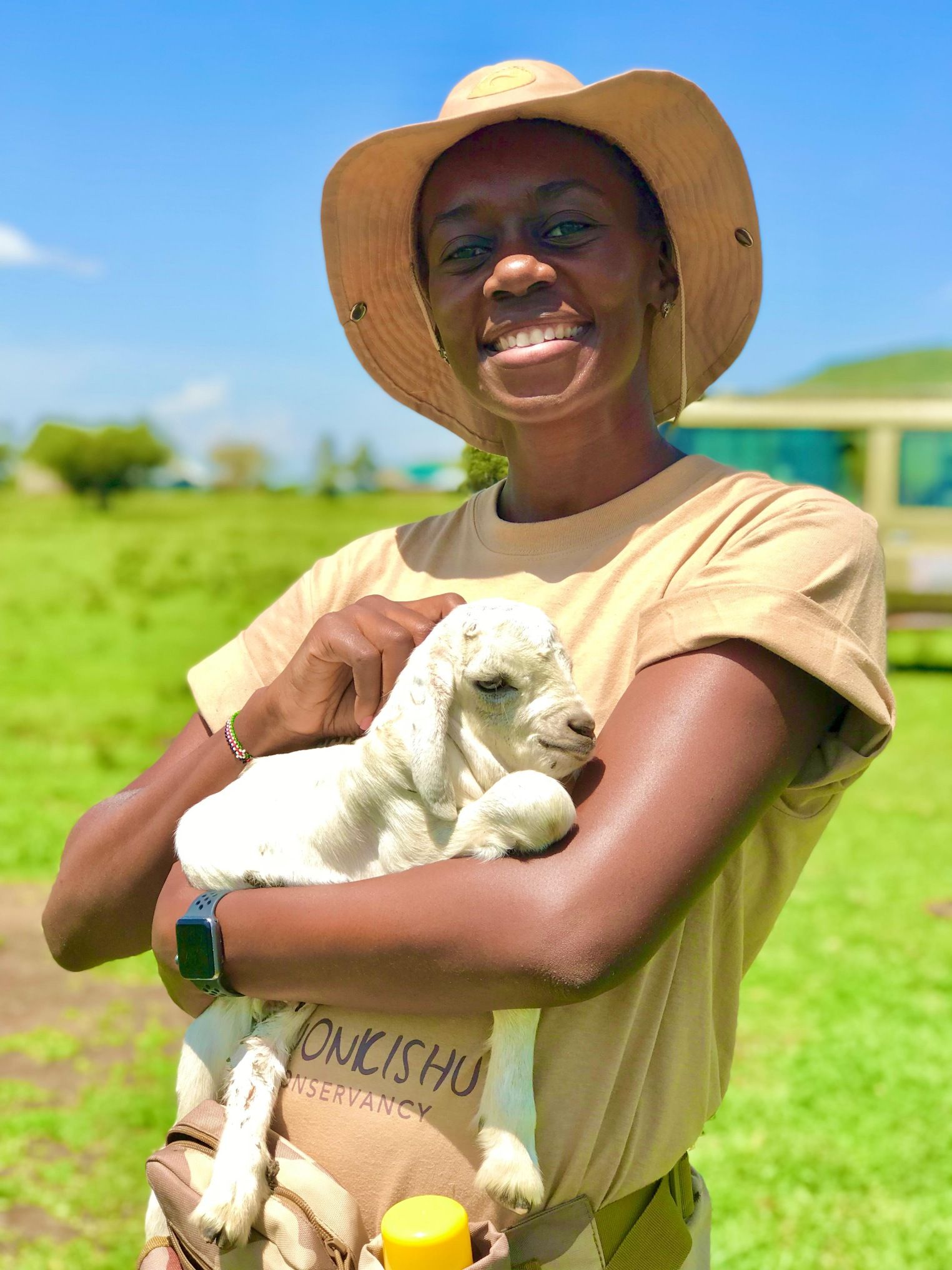
Today, Charlotte runs two branches, one in Mombasa and one in Kilifi. Alongside her clinic work, Charlotte also treats wildlife and marine life along the Kenyan coast.

“I am a vet, but more than that, I am an animal lover,” she says.
***
There are two things she knows she has to do.
The first is education.
“We need more awareness,” she says. “People need to know how to treat animals.”
To this end, she is developing an educational program at a school, where she hopes to start an animal welfare club for young children.
“If they learn when they are young,” she says, “they won’t grow up watching an adult mistreat an animal and stay quiet.”
The second thing Charlotte wants to do is open an animal shelter in Kilifi. There isn’t one there now, and in reality, she is already doing the work of a shelter.
People abandon animals at her clinic, and Charlotte is left with the responsibility of feeding them, treating them, finding homes for them, or keeping them herself.
“That’s how we ended up with so many pets,” she says, smiling. “And we’re still counting.”
***
When Charlotte looks back at how everything unfolded, it feels like alignment.
“I can’t think of anything else I would rather do,” she says.
Once, one of her patients, a Rottweiler, attacked her. The physical pain was severe, but it wasn’t what frightened her most.
“What if I can’t face a dog after this?” she remembers thinking. “What am I going to do with my life?”
Slowly, she worked through it. The fear loosened its grip, and she returned to work.
What hurts most, she admits, is seeing animals suffering at the hands of humans.
“It breaks my heart,” Charlotte says.
She remembers a quote she once heard.
If you’ve never been loved by an animal, you don’t know love.
Because, she explains, there is no love as unconditional as that. They forgive without keeping score. They stay, even when they are hurt.
“And for people to just not see that…” Charlotte doesn’t finish the sentence. She doesn’t need to.
***
Thanks to the WE Africa Leadership program, Charlotte has learned how to ask for help. She has also learned the art of finding balance.
The day before this interview, after everything she had seen and carried, she went home to her partner. He is the one she unloads everything onto.
“He asked me, ‘What do you need?’” she recalls.
“A gin and tonic. And lots and lots of hugs,” she said.
He took her to a beach restaurant. He bought her good food. A gin and tonic. And he held her.
“These are things I’ve learned to ask for,” Charlotte says.
She no longer believes she has to drown in the sadness to make a difference. She can find pockets of time for joy, too. And on days when she spends time with puppies and kittens, she remembers exactly why she stays.
*Some names in this story have been changed to protect the subjects' privacy.
***
This interview is part of a series profiling the stories of the 2025 WE Africa leadership programme fellows. African women in the environmental conservation sector who are showing up with a strong back, a soft front, and a wild heart.
***
About Dr Charlotte Wambura
Dr Charlotte Wambura is an accomplished veterinary surgeon with 15 years of experience in the field. She is the founder and Chief Veterinarian at Charlie's Pet Care, where she leads a dedicated team in prioritising the well-being of all creatures great and small.
Dr Wambura has served as an active executive Committee member of the Kenya Small and Companion Animals Veterinary Association. She is a licensed wildlife veterinarian with the Kenya Wildlife Service and an executive committee member of the Kenya Veterinary Association - Wildlife Branch. Additionally, she is a member of the Kenya Marine Mammals Stranding Network who works with the Kenya Marine Mammal Research and Conservation, demonstrating her commitment to marine conservation.
She is a firm believer in the One Health approach and understands the interconnectedness of human, animal and environmental health. She is passionate about animal welfare and conservation. Dr Wambura strives to enhance the well-being of animals, both domestic and wild, making significant contributions to veterinary medicine, wildlife and marine preservation in Kenya.